
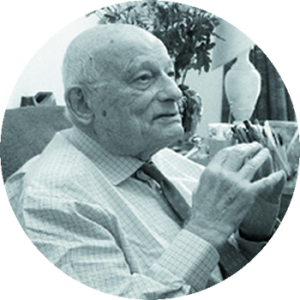
 I received a homework assignment from Dr Ledermann before I actually met him. I had begun a course in homeopathy for medical doctors at what was then known (and for me will always be known) as the Royal London Homoeopathic Hospital (RLHH)*. It required me to read two articles by him, published in the British Homeopathic Journal. They were not really about homeopathy at all, but about his views on what a holistic approach in medicine actually meant.
At his first tutorial, I found myself riveted by his enthusiasm, academic soundness and the philosophic underpinning of his ideas. I attended his clinics and had the privilege of being able to read all his books and be able to discuss everything with their author. They include: Existential Neurosis(1972), Good Health through Natural Therapy (1976), Mental Health and Human Conscience (1984), Philosophy and Medicine (1986) Your Health in Your Hands (1989). Eric became my primary mentor in medicine, and I learned the following important lessons directly from him about physical and psychological medicine.
Physical Illness:
The body is a self-healing organism. In most situations, it is able to repair itself. When it is not doing this, a medical intervention is justified. If there is a risk of mortality or morbidity (irreversible change) one must use conventional scientific medicine immediately.
- Meningitis: Immediate antibiotics
- Appendicitis: Immediate surgery
- Subdural haematoma: Immediate neurosurgery.
- Testicular torsion immediate surgery: (This is a good example of where surgery must be implemented asap to avoid morbidity – in this case, the loss of a testicle)
Also where a total cure is available in a chronic situation it must be essayed.
- Syphilis: an injection of very strong penicillin is a miraculous cure of a disease that used to cause huge untold misery.
- Cataracts: Ophthalmological surgery is usually dramatically successful.
However, in many situations where there is no risk of morbidity or mortality, we need not rush to a mechanistic approach to fix the part. Here we have the chance to use a HOLISTIC STIMULUS to stimulate the body to do its job and heal itself. Such an approach is always aimed at the whole person and is individually tailored to their particular situation.
Examples of Holistic Stimuli:
- Patient passive: Homeopathy, acupuncture, osteopathy.
- Patient active: Diet changes, exercise, yoga, meditation.
If the patient doesn’t respond to a holistic stimulus, one can always resort to the more mechanistic approach of conventional medicine. The main point here is that, where it is safe to do so, we should try holism first to try to stimulate the body to heal itself.
Psychological Illness:
A student of Alfred Adler and fully psychoanalysed himself, Ledermann eventually disagreed with Freud about the purpose of psychoanalysis. For Freud, it was to ‘take responsibility for unconscious processes. For Ledermann, this was not enough. Axiomatic for Ledermann was his belief that we are all (with the exception of psychopaths) endowed with a conscience of which we may or may not be strongly in touch with. The purpose of therapy, therefore, is to help the patient make his/her unconscious conscience conscious.
This tongue twister changed the way I deal with psychological problems. Ledermann used art therapy and hypnosis to do this. When LSD was legal, he used it to help patients who had become ‘stuck’ in therapy. Interestingly, psychedelic-aided psychotherapy has recently made a massive comeback as a treatment in many parts of the world.
I would go on to use Provocative Therapy, the use of warmhearted humour and reverse psychology (with permission of course!) to provoke people to get more in touch with their consciences.
A serious man on a mission, Eric was my most important teacher in medicine as he left me with a structure to practise both physical and psychological medicine, which also explained how the mind and the body are connected.
*For more on the RLHH, who built it and what happened to it, have a listen to me on this recently recorded podcast: https://pod.co/the-medical-protocols-series